Converting steam heat to hot water in Bridgeport homes
Replacing a steam system with a hot-water boiler and piping, reusing radiators where they can take it, for quieter, more even and more efficient heat.
A steam-to-hot-water conversion in Bridgeport replaces a steam boiler with a hot-water boiler and changes the piping so heated water, not steam, circulates to the radiators. It gives quieter, more even heat, allows zoning and condensing boilers, and removes steam's water-level issues. But it usually needs new piping and radiator checks, so it costs more than a like-for-like steam boiler.
Updated October 2026
When converting makes sense
Steam systems can run well for decades, and replacing a steam boiler with another steam boiler is usually the cheaper route. Conversion makes sense when the steam system is noisy and uneven despite repairs, when the owner wants zoning or a condensing boiler, or when a renovation opens walls and makes new piping practical.
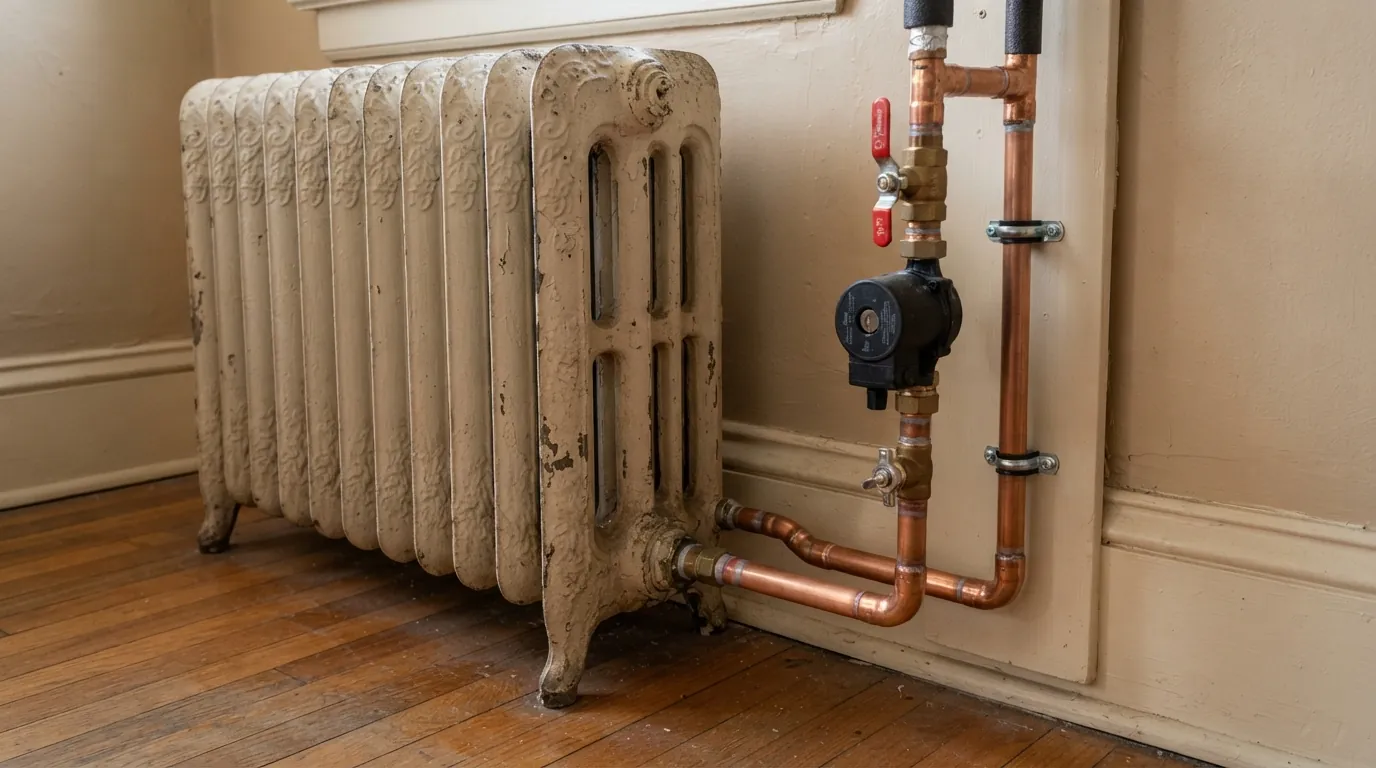
The key questions are whether the existing radiators can take pressurized hot water and how the piping will run. One-pipe steam radiators were not always built for hot water, and one-pipe steam piping does not carry water the way a hot-water system needs, so we assess both before quoting.
What decides the cost of a conversion
Piping
Adding returns or repiping the house.
Radiators
How many can be reused versus replaced.
New boiler
Condensing or cast iron hot-water boiler.
Zoning
Number of zones, valves and thermostats.
Access
Finished walls and ceilings make routing harder.
Old boiler removal
Removal of the steam boiler and controls.
Convert to hot water or replace the steam boiler?
| Option | Good fit when | Tradeoff |
|---|---|---|
| New steam boiler | The steam system works well apart from the boiler | Keeps steam's noise and uneven heat |
| Steam-to-hot-water conversion | You want quieter heat, zoning or a condensing boiler | Higher cost; piping and radiator work |
| Heat pumps with steam backup | You want cooling and lower running costs | Two systems; steam stays for cold days |
Converting One-Pipe Steam to Hot Water
One-pipe steam systems use a single pipe to each radiator, with steam going up and condensate coming back down the same pipe. Hot water needs a supply and a return, so conversion means adding return piping to each radiator or repiping the system. Radiators are checked for their ability to hold water under pressure, since some steam radiators have no water connections at the top or bottom that suit hot water. We map every radiator and pipe route before recommending conversion. Some one-pipe systems convert cleanly; others are better left as steam with a new boiler.
Radiator Reuse and Repiping
Cast iron radiators that were built for hot water, or steam radiators with sections joined at both top and bottom, can often be reused, and reusing them saves a great deal of cost and plaster work. Radiators that cannot take pressure are replaced with panel radiators or baseboard sized to the room. New piping is routed through basements, closets and walls as neatly as possible. We pressure test the radiators we plan to keep before committing to them. Any radiator that weeps under test is flagged, and the room gets sized new radiation instead, so there are no surprises after the system is filled.
New Boiler and Zoning for the Converted System
With hot water, the new boiler can be a high-efficiency condensing model. The house can be split into zones with their own thermostats, which steam systems cannot easily do. We size the boiler to the house's heat loss rather than the oversized steam boiler it replaces, add circulators or zone valves, and set up outdoor reset so the water temperature follows the weather. See boiler installation and steam boiler service. The old steam boiler, its water-level controls and the main vents are removed. The near-boiler piping is replaced as part of the job, leaving a clean, organized boiler room.
How this job plays out in Bridgeport
Through the CT Green Bank, the Smart-E Loan finances qualifying energy upgrades, including HVAC work, from $5,000 to $40,000, with the work done by participating contractors. Because a steam-to-hot-water conversion is a larger project than a straight boiler swap, homeowners planning one often check whether it qualifies before settling on a budget. We can give you a written quote to take to a lender, with the conversion and a steam replacement priced side by side.
We service and install Carrier, Lennox, Trane, Goodman and more
How a steam conversion runs
- 1
Assess the system
Radiators, piping and boiler surveyed.
- 2
Pressure test radiators
Candidates for reuse tested.
- 3
Heat loss and design
Boiler, piping and zones designed.
- 4
Written quote
Conversion priced against a steam replacement.
- 5
Repipe
Supply and return piping installed.
- 6
Install boiler and zones
New boiler, circulators and controls.
- 7
Fill, purge and balance
System filled, air removed and balanced.
How long a conversion takes
A full conversion usually takes several days to a couple of weeks, depending on how much piping and radiator work is needed and how accessible the walls are. It is best scheduled outside the heating season, or during a renovation when walls are already open, so the house is not without heat for long.
Steam-to-Hot-Water Conversion questions from Bridgeport homeowners
When you want quieter heat, zoning or a condensing boiler, often yes; it costs more than a steam replacement.
Often, if they can hold pressurized water; we test them.
Several days to a couple of weeks.
Hot water allows condensing boilers and zoning, which usually improves efficiency.
Yes, usually; conversion is a larger project.
The CT Green Bank Smart-E Loan finances qualifying projects.
Related jobs we handle
Boiler Installation & Replacement
Gas, oil, condensing and combi boilers for radiator homes.
Boiler Installation & Replacement in BridgeportSteam Boiler Service
Banging pipes, cold radiators and low-water faults on steam.
More on steam boiler serviceFind out if conversion fits your house
Call to book an assessment. We test the radiators and price conversion against a steam replacement.