What a boiler replacement costs in Bridgeport and across Connecticut
The published price ranges, the parts of the job that move the number, and the questions that make two quotes comparable.
By Eleanor Boyer, HVAC Guides Editor · Updated October 2026
Published figures put a boiler replacement at about $3,700 to $8,300, and up to $12,000 for a high-efficiency unit, with oil boiler replacements at about $4,800 to $9,000. Where your job lands depends on the boiler type, venting, piping changes, the chimney, permits and whether an indirect water heater is part of the work.
The published ranges
National and Connecticut cost guides put a standard boiler replacement at about $3,700 to $8,300, with high-efficiency condensing boilers reaching about $12,000. Oil boiler replacements are published at about $4,800 to $9,000. Connecticut work tends to run above national averages, so treat the low end of any range with caution and expect older houses to land in the middle or above.
Those ranges cover the boiler and a normal installation. The items below are what turn a simple swap into a larger job, and they explain most of the difference between two quotes for the same house.
Boiler type and efficiency
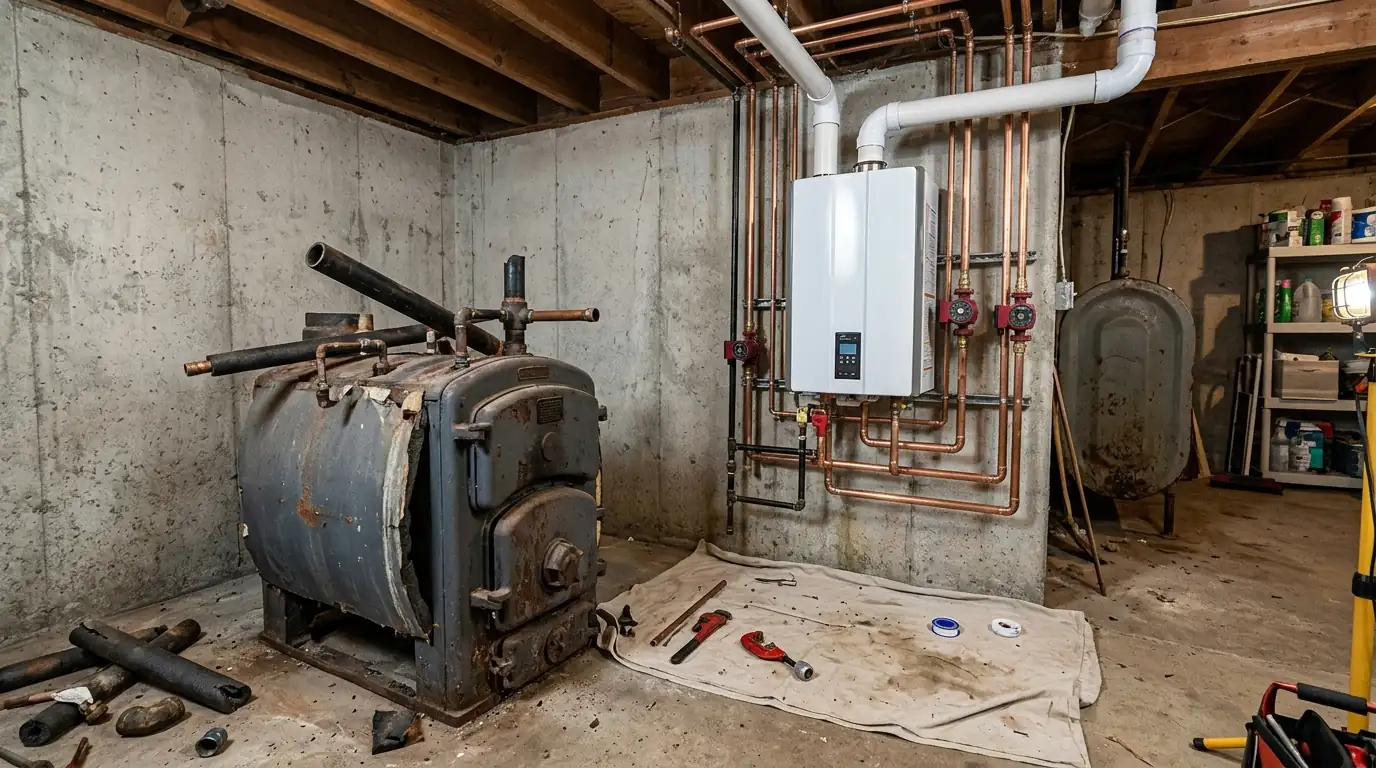
A standard cast-iron boiler that vents into a chimney is usually the least expensive to buy and install. A condensing boiler costs more but burns less fuel, and it vents through the wall with plastic pipe instead of the chimney. A combi boiler adds domestic hot water in the same unit and can replace a separate water heater. See boiler replacement options for how we match the type to the house.
Venting and the chimney
Moving from an old boiler to a new one often changes the venting. A standard boiler going into an old masonry chimney usually needs a liner, and a condensing boiler needs a new sidewall vent and a condensate drain. If the water heater still uses the chimney after the boiler leaves it, the chimney may need a smaller liner so that heater vents safely.
Piping, controls and zones
Older systems were often piped for the boiler they had, not the one going in. Near-boiler piping, new circulators or zone valves, an expansion tank, air separation and an outdoor reset control are common additions. They add cost, but they are also what let a high-efficiency boiler actually run efficiently.
Steam is its own case
Steam boilers cost more to replace than most hot-water boilers because they have to be sized to the radiators, not just the heat load, and the near-boiler piping has to be built correctly or the system bangs and spits. If your house has steam, ask whether the quote includes a radiator survey and new near-boiler piping. See steam heat service for what that work involves.
Pricing a boiler replacement?
We measure the house and the radiators before we quote, so the number reflects your system.
(203) 568-0715Permits, removal and the oil tank
Boiler replacements in Connecticut need a building permit and inspection, and published permit fees in towns such as Milford run about $100 to $300. Removing the old boiler is usually included, but removing an oil tank after a conversion is a separate line. If you are leaving oil, ask whether the tank, the fill and vent pipes and the old burner are part of the price.
How to compare two quotes
Line up the boiler model and its efficiency, the venting plan, what piping and controls are included, the permit, removal of the old equipment and any tank, the warranty, and whether a heat-loss calculation was done. A quote that is much lower usually leaves one of those out. A quote that sizes the boiler from the old nameplate instead of the house is the one to question.
Paying for it
Connecticut's Smart-E Loan through the Green Bank finances qualifying upgrades from $5,000 to $40,000 through participating contractors, and utility programs sometimes offer incentives on high-efficiency equipment. Ask what applies to your address before you sign, because programs change and some require approval before the work starts.
More guides for Bridgeport homeowners
Heat Pump Cost in Connecticut, Before and After Rebates
Published Connecticut heat pump prices, Energize CT rebate figures, and what changes the cost for ducted and.
Read the guideWhy One Radiator Stays Cold While the Others Heat
Steam or hot water, the usual reasons one radiator stays cold, what you can safely check, and when a.
Read the guideHow Long Does a Boiler Last in a Connecticut Home?
Typical boiler lifespans for cast iron, steel and condensing boilers, the warning signs of age, and how to.
Read the guideCommon questions
Published ranges run about $3,700 to $8,300, and up to $12,000 for high-efficiency units, before extras like venting and piping changes.
Published oil boiler replacements run about $4,800 to $9,000, partly because of the burner, venting and tank work.
Often, if a standard boiler vents into an old masonry chimney. Condensing boilers vent through the wall instead.
Usually, in a house that will be kept for years, because it burns noticeably less fuel.
Yes, a building permit and inspection are part of the job in Connecticut towns.
Different venting, piping, controls, removal and sizing assumptions. Compare them line by line.
Get a real number for your house
Call to book a visit. We look at the boiler, the venting and the radiators before we price anything.