Steam or hot water radiators in your Bridgeport home: how to tell
A quick way to identify your system, what each type needs to run well, and why the difference changes every repair and replacement decision.
By Eleanor Boyer, HVAC Guides Editor · Updated October 2026
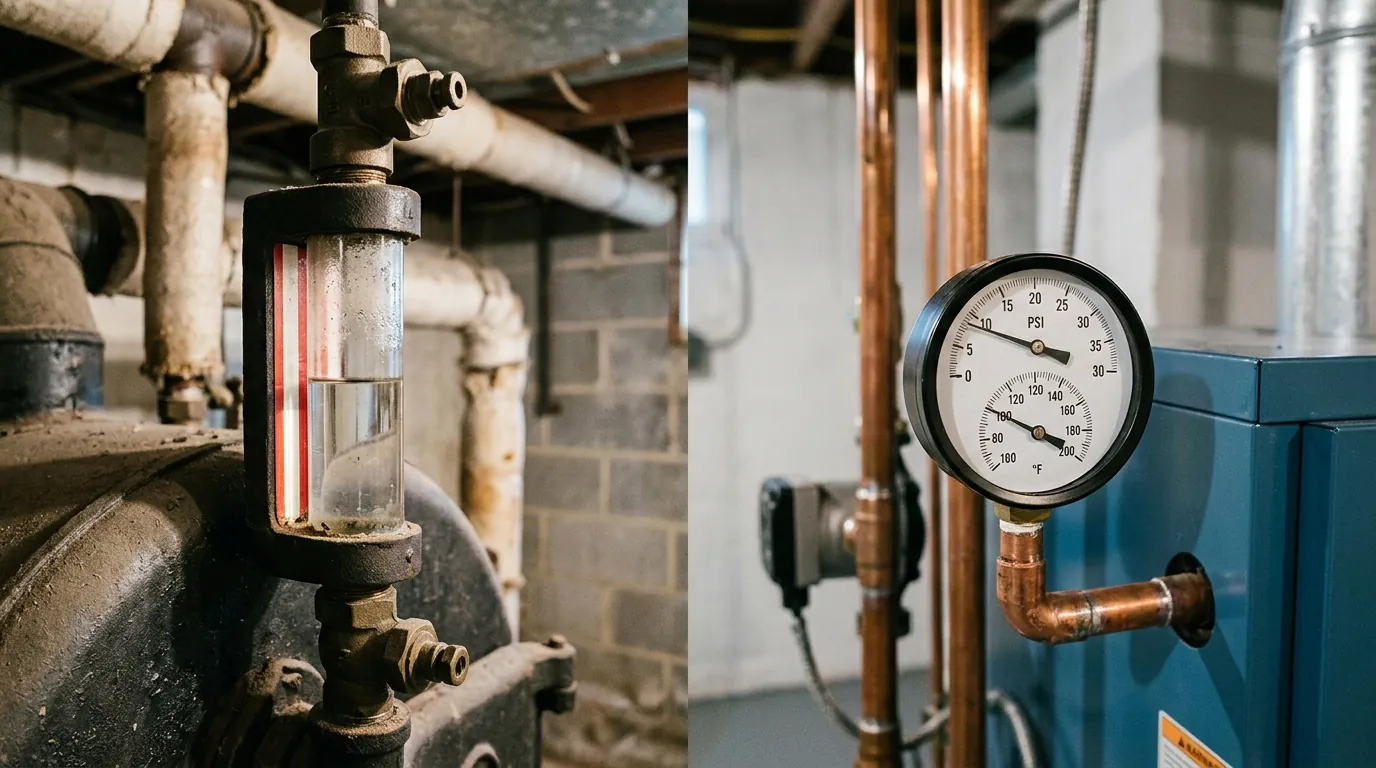
The fastest way to tell is the boiler: a steam boiler has a glass sight tube showing the water level and a pressure gauge reading only a few psi, while a hot-water boiler has a combined pressure and temperature gauge around 12 to 25 psi and an expansion tank nearby. Steam radiators also have a small air vent on the side.
Why so many Bridgeport homes have radiators
Bridgeport has some of the oldest housing in Connecticut, with roughly a third of homes built before 1940. Those houses were built for coal, then converted to oil, and most kept the radiators and piping they started with. That is why radiator heat is so common here, and why the question of steam or hot water comes up on so many service calls.
Look at the boiler first
A steam boiler has a glass sight tube on the side, usually about halfway up, with visible water inside. Its pressure gauge reads in low numbers, often zero to a few psi, and many have a low-water cutoff and a pressure control called a pressuretrol mounted on top.
A hot-water boiler has no sight glass. Its gauge usually shows both pressure and temperature, with pressure around 12 to 25 psi when running. You will usually find an expansion tank nearby, either a small bladder tank hung on the piping or an older steel tank near the basement ceiling, and one or more circulator pumps.
Then look at the radiators
Steam radiators usually have one pipe at the bottom and a small air vent partway up the far side, which hisses when the heat comes on. Two-pipe steam systems have a pipe at each end and a trap instead of a vent. Hot-water radiators have two pipes, often one at the top and one at the bottom, and a small bleed valve at the top that you open with a radiator key. Baseboard fin-tube heat is almost always hot water.
Why the difference matters for repairs
Steam systems depend on correct water level, working air vents and proper pipe pitch. Banging pipes, radiators that never heat, and water spitting from vents usually point to one of those. Hot-water systems depend on pressure, circulation and getting air out of the lines. Cold upper floors, gurgling and a relief valve that drips usually point to air, a failed expansion tank or a weak circulator.
Knowing which you have also keeps homeowners from doing the wrong thing. Bleeding is for hot water. Adding water manually is a steam task, and never on a hot boiler with an empty glass. See how we repair boilers for the faults we fix most.
Not sure which system you have?
Send us a photo of the boiler or call, and we will tell you what you are looking at.
(203) 568-0715Why it matters for replacement
Steam boilers are replaced with steam boilers, and they have to be piped exactly to the manufacturer's diagram, including the header, or the new boiler will surge and bang. Hot-water systems give more options: a new cast iron boiler, a wall-hung condensing boiler, or a combi unit in a smaller home. Converting steam to hot water is possible but usually means new piping and sometimes new radiators, so it is rarely the cheapest route.
A hot-water system also opens the door to an indirect water heater off the boiler and, later, a heat pump for part of the heating season. See our boiler installation work for how those choices play out.
Common myths about radiator heat
One myth is that radiators are inefficient by nature. Cast iron holds heat well and releases it slowly, which is comfortable; the inefficiency usually sits in an old, oversized boiler, not in the radiators. Another is that a noisy steam system is normal. Some sound is, but loud banging means water is trapped somewhere it should not be, and it can usually be fixed by correcting pipe pitch or the water level.
A third is that you need ducts for air conditioning. You do not. Ductless mini splits cool radiator homes without touching the heating system, which is why they are so common in older Bridgeport houses.

Small habits that keep either system happy
For steam, check the sight glass monthly during the heating season, keep radiator vents unpainted and open, and do not block radiators with furniture or covers that trap heat. For hot water, glance at the pressure gauge now and then, bleed radiators that stay cool at the top, and let a technician check the expansion tank and circulators once a year.
More guides for Bridgeport homeowners
Energize CT HVAC Rebates in 2026: What Qualifies
What Energize CT pays in 2026 for heat pumps and central air, how Energy Optimization works, and what ended.
Read the guideSigns Your Furnace Is Failing Before Winter
Short cycling, rising bills, odd noises and cold rooms: what each furnace warning sign means and when to.
Read the guideDuctless vs Central Air in Older Bridgeport Homes
Radiator heat and no ducts? How ductless mini splits, central air and high-velocity systems compare in older.
Read the guideCommon questions
Look for a sight glass on the boiler, a low pressure gauge and air vents on the radiators.
No. Steam radiators use automatic air vents; bleeding is for hot-water systems.
Usually water trapped in pipes that have lost their pitch, or a water level set too high.
Hot water is more efficient and easier to control, but converting a steam house is expensive.
Not directly; condensing boilers are hot-water only.
Once a year, before the heating season.
Get your radiator system checked
Call to book a boiler visit. We will identify the system, check it and tell you what it needs.